Your repository
Code arrives as pull requests on feature branches in your own GitHub. You review and merge; nothing is pushed to main.
Weeks lost to work that isn’t building. Features that aren’t what was meant. Nobody sure where things stand. VrittOS takes the work around the code off your plate, so your team spends its time on decisions, not chasing.
14-day free trial 100 credits included No credit card required
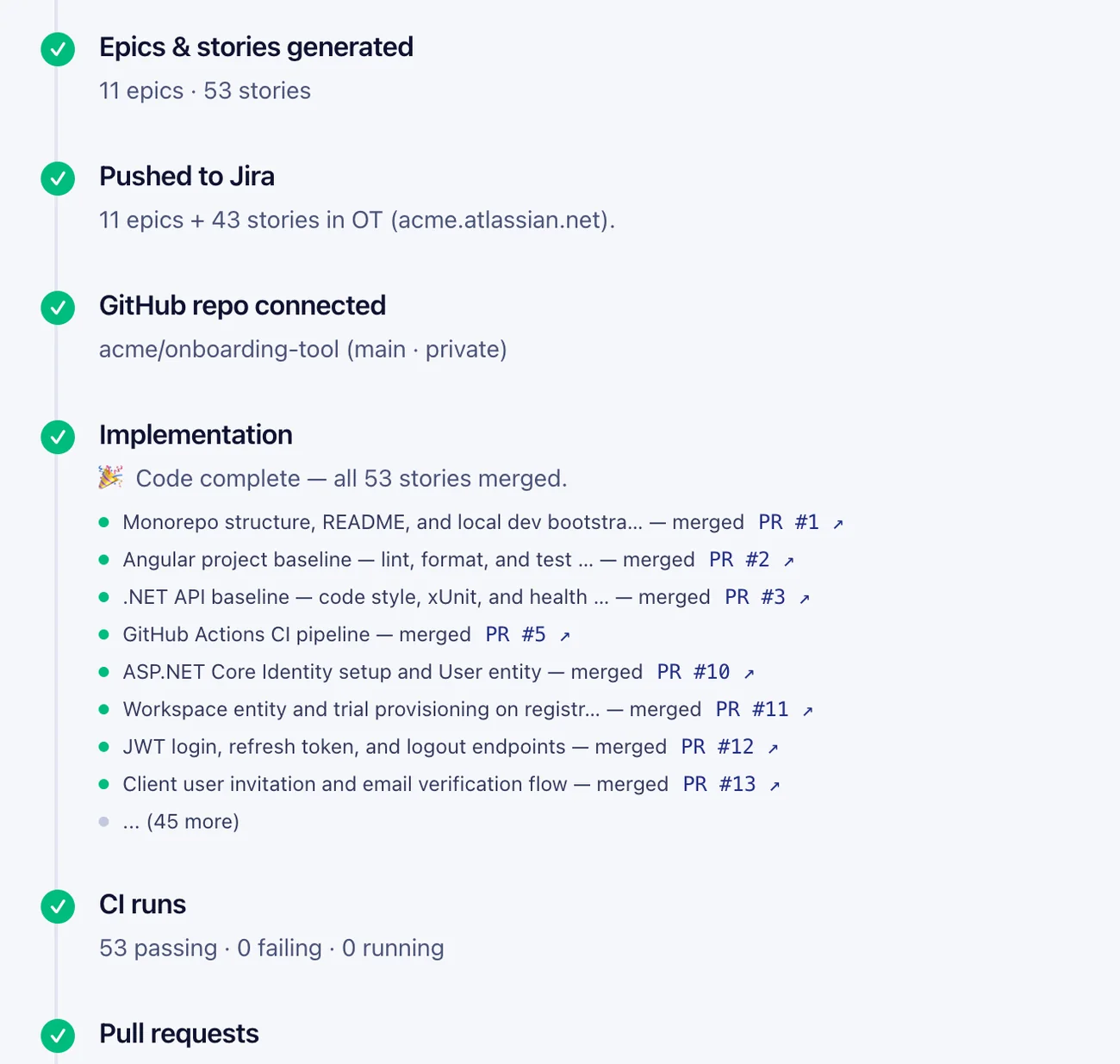
Integrations are part of the process — code ships to GitHub, your backlog syncs to Jira, and your app goes live on Vercel, Netlify, Railway, Render or Appetize
Most teams lose more to these than to anything technical. Here is what each one looks like — and what changes.
Ask a team where their time went and very little of the answer is “building”. It went on writing tickets, explaining the product again, chasing reviews and fixing builds that broke for reasons nobody chose.
No more blank pages
An idea becomes a brief, screen designs and a backlog with acceptance criteria in a single sitting — the groundwork that usually eats the first week.
The busywork happens without you
When one pull request merges, the open ones it conflicts with are rebased and re-checked. A failing build gets a fix attempt before anyone is asked to look.
Context is never re-explained
Each new feature is planned with what was already decided and already built in hand, so the tenth feature starts as quickly as the first.
Median time from signing up to a first tested pull request: under 2 hours.
Most rework is not a coding mistake. It is a misunderstanding that nobody noticed until it was built — because the questions that would have caught it were never asked.
The awkward questions come first
Before anything is planned you are asked what a good product person would ask — who it is for, what “done” looks like, and what is deliberately out of scope.
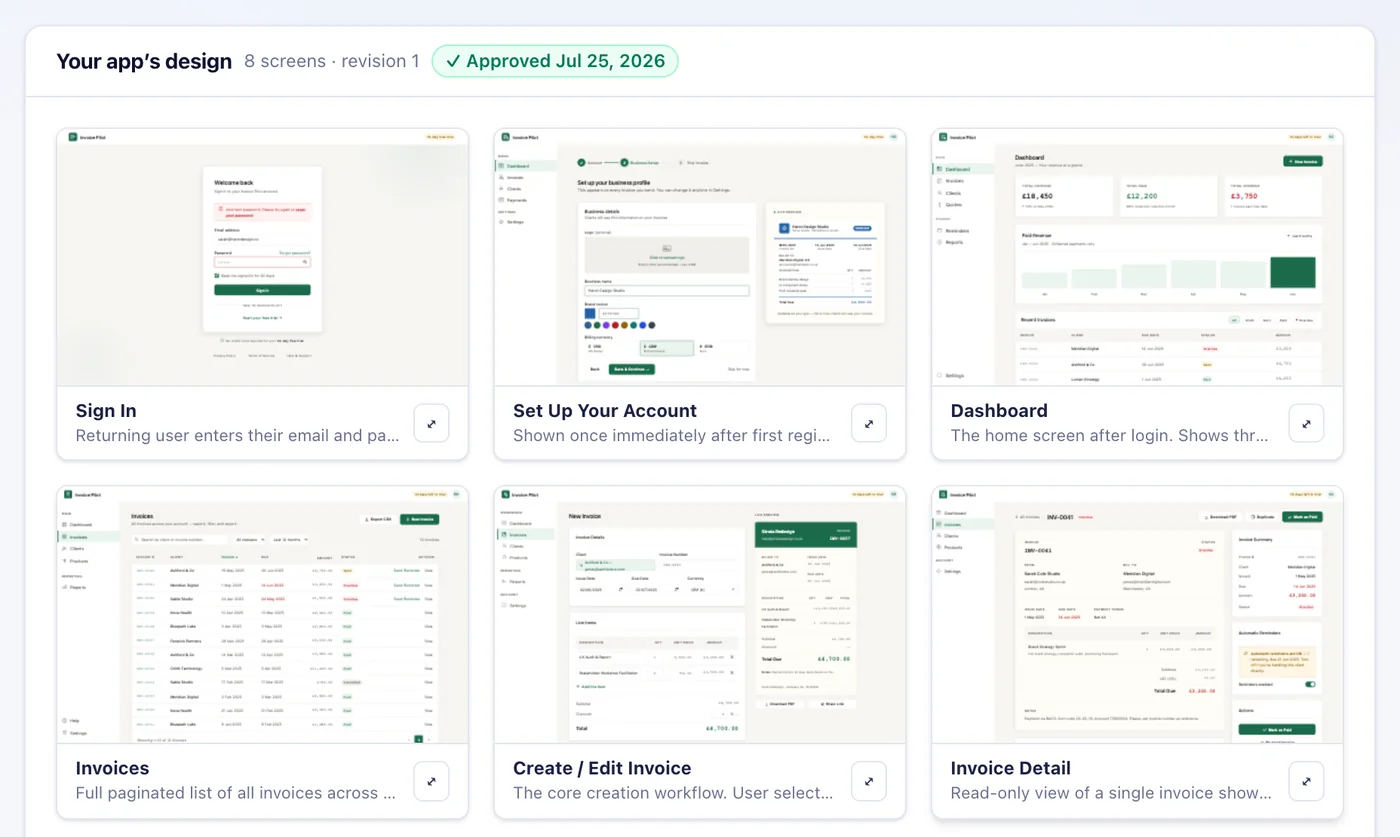
You see it before it is built
Screen designs come back for your approval before a line of code is written, so a wrong turn costs a comment rather than a sprint.
“Done” is written down
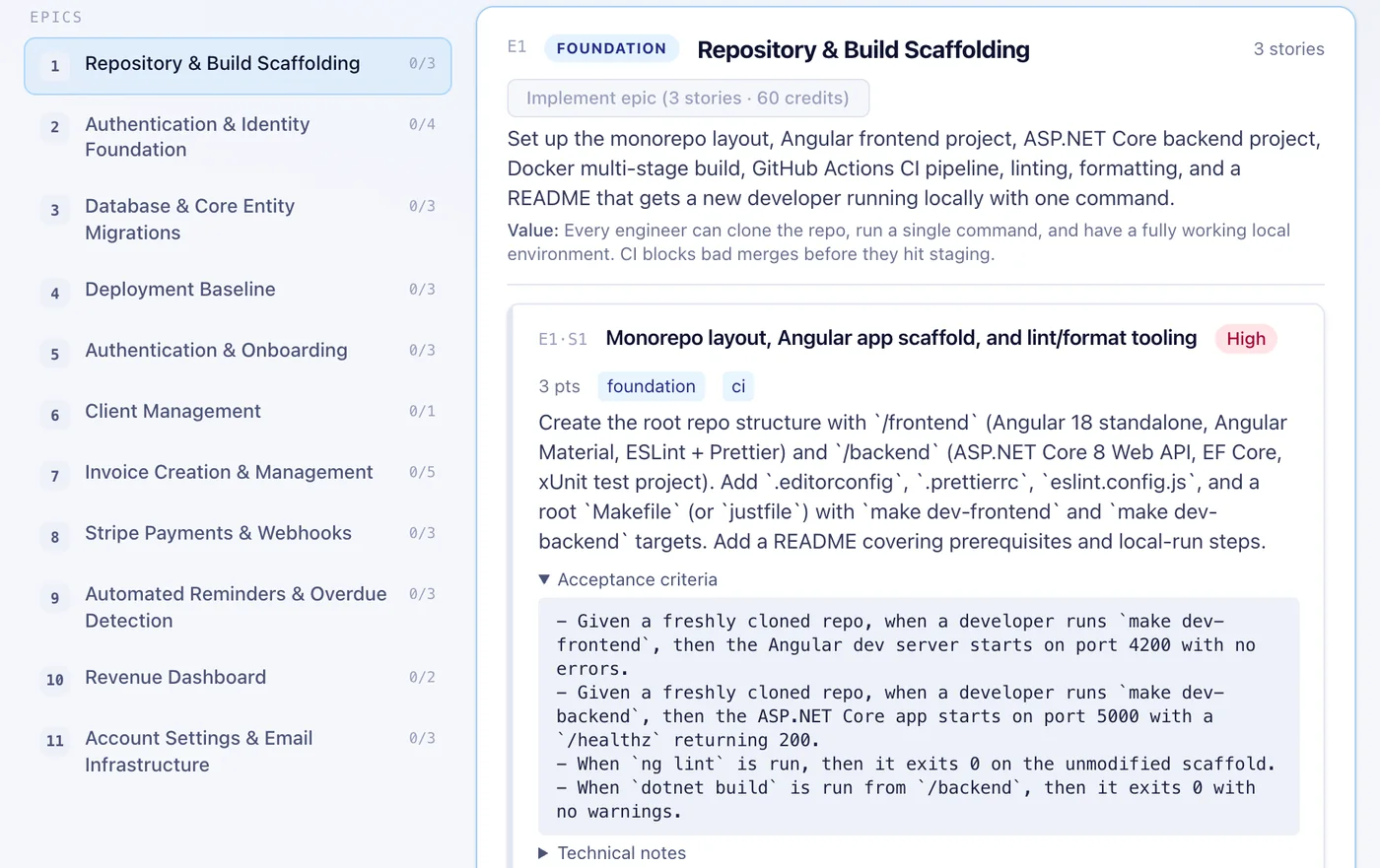
Every story carries Given / When / Then acceptance criteria and traces back to the requirement it came from. Every pull request traces back to its story.
Nothing is built until you have agreed what “done” means.
The question every founder and manager asks, and the one that interrupts everyone who has to answer it. When status lives in people’s heads, you only find out something is stuck once it has been stuck for days.
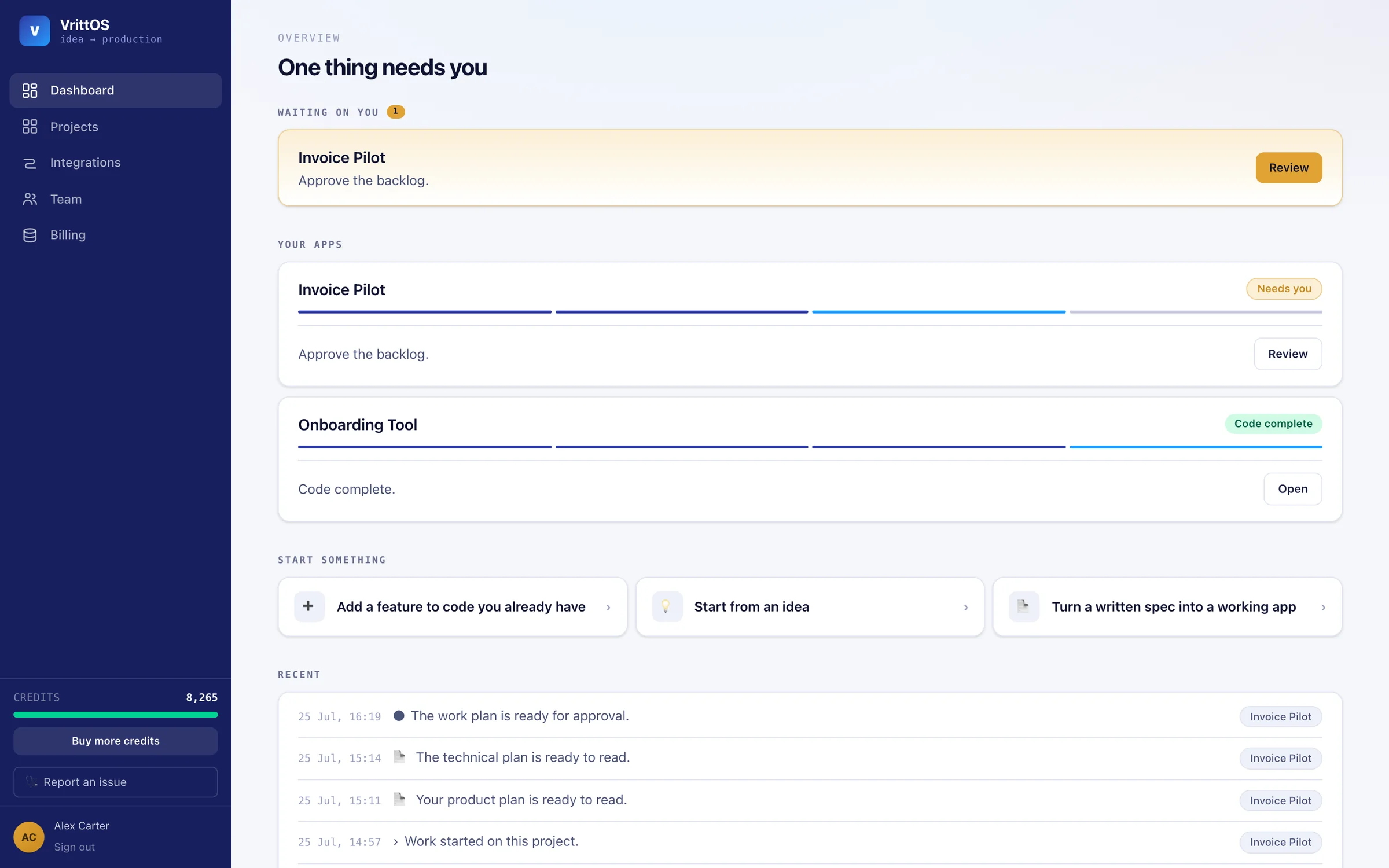
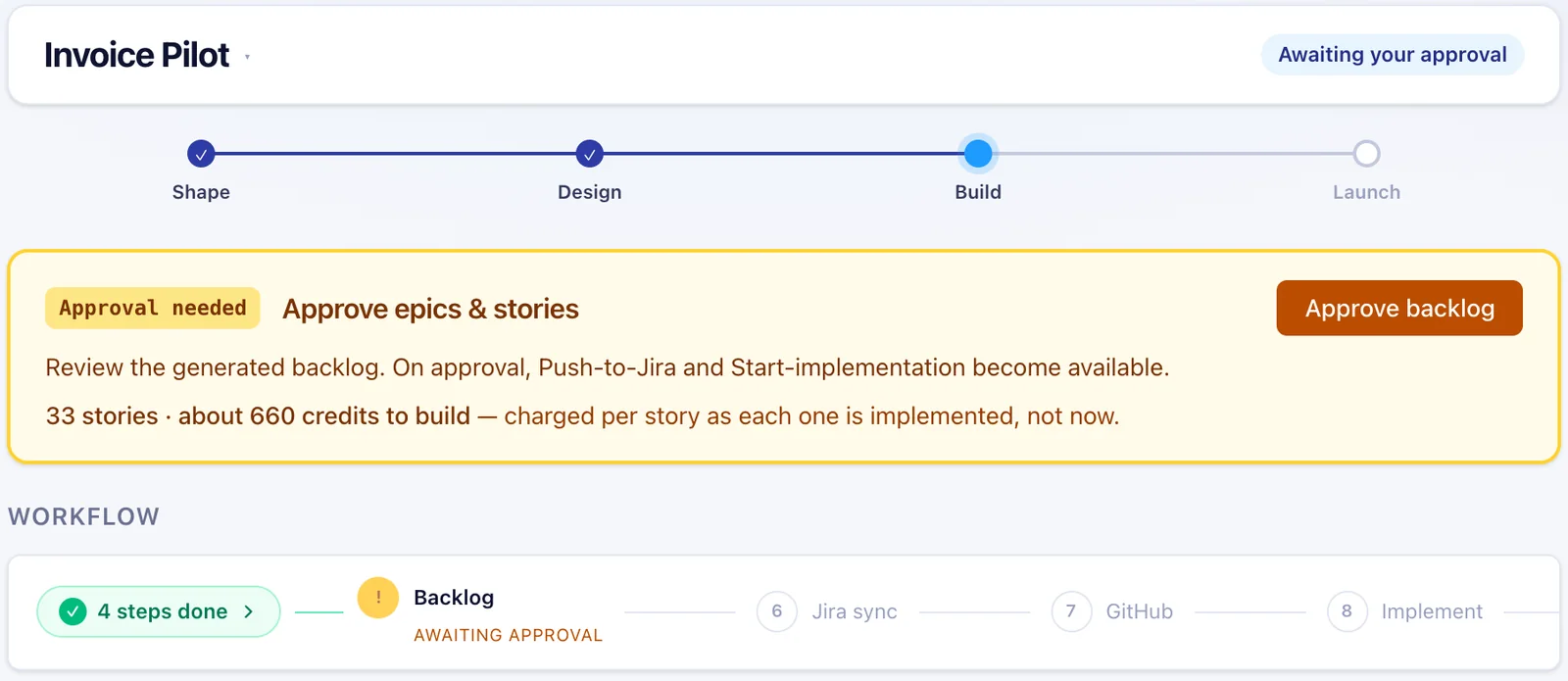
Every piece of work shows where it is
What has happened, what is happening now and what comes next — in plain language, with the one action that needs you clearly marked.
The tracker keeps itself honest
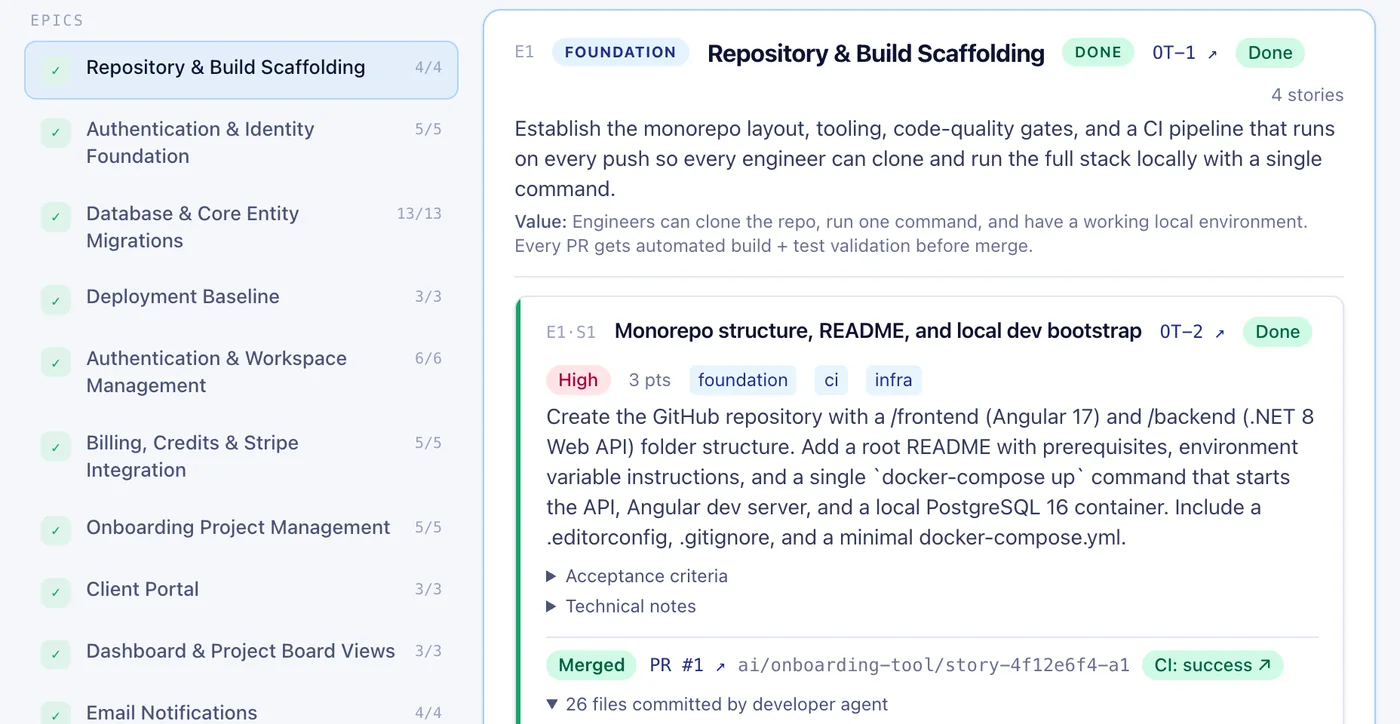
Story statuses flow back to Jira as work moves, so the board matches the code without anyone updating it by hand.
Bad news arrives early
When main goes red, new work waits and you get the cause with the evidence attached. On the Growth plan, approvals waiting, pull requests opened and failing builds also reach your team in Slack or Teams.
Know where every feature stands without asking anyone.
Quality drifts quietly. A different pattern here, a skipped test there, a shortcut under deadline — until the codebase feels like five projects stitched together and every change is slower than the last.
Your standards, applied every time
Write down how your team builds once — naming, structure, testing, the patterns you like and the ones you don’t — and every change follows them.
One path for every change
A feature branch, tests written and run, and a pull request that states what changed, what was tested and what is known not to work. Never straight to main.
New work extends what exists
Features are planned against the modules and tech stack already in your repository, so they grow the product instead of being reinvented beside it.
The fortieth pull request looks like the first.
Requirements live in a document, tickets in Jira, code in GitHub and the decisions in a chat thread nobody can find. Each hand-off between them loses something, and the people on either side stop seeing each other’s work.
One thread from idea to release
Requirement, story, pull request and deployment are each linked to the one before, so anyone can follow a change back to the reason it exists.
In the tools you already use
Your GitHub, your Jira, your Slack or Teams and your own hosting. Work flows between them; nobody re-types it.
Everyone looks at the same thing
Founders and product see plain-language progress and decisions; engineers see the stories and the diffs. Same work, same source, no translation.
Nothing to copy between tools, because nothing lives in only one.
No new methodology, no migration. VrittOS fits around the way you already deliver.
Code arrives as pull requests on feature branches in your own GitHub. You review and merge; nothing is pushed to main.
Approved epics and stories land in your Jira project. Jira stays the place your team plans from.
You approve the plan before code is written and the pull request before it merges. Every step in between is visible.
Know which situation you are in? I have a codebase →I have an idea →My v1 exists →
Built with VrittOS
A founder described a fragrance boutique — no wireframes, no stack chosen, no code written. VrittOS designed it, planned it, and delivered 41 user stories as reviewed pull requests.

Maison Aura — Fragrance e-commerce, built and operated by a VrittOS customer.
Perspectives from the strategists, engineers, and product leaders who have looked closely at how VrittOS approaches agentic AI.
VrittOS represents a practical shift in how businesses can use AI—not simply as a tool, but as an intelligent layer that can coordinate work and drive outcomes. What stands out to me is the vision of bringing agents, workflows and business context together into one operating environment. It has the potential to fundamentally change how teams approach automation.
The real value of enterprise AI comes when it can understand context, interact with systems and take meaningful action. VrittOS is moving in exactly that direction. Its approach to combining AI agents with structured workflows provides an interesting foundation for applying agentic AI to complex, real-world business processes.
What I find compelling about VrittOS is its focus on outcomes rather than individual AI interactions. From a product and quality perspective, AI becomes far more valuable when it can operate within defined workflows, maintain context and work within clear controls. VrittOS brings those ideas together in a way that feels relevant to how businesses will actually adopt agentic AI.
Start with a 14-day free trial and 100 credits — no card required. After that you keep your workspace on Pay as you go and buy credits as you need them, or pick a plan for a monthly allowance.
Project limits count what you're running at once — archive a project any time to free a slot. Archived work is kept, not deleted. Adding a feature to a project you've already built never uses another slot. Starting from a repository you already have costs 20, 40 or 80 credits by its size — quoted for free before you start.
50% off your first 3 months — applied automatically at checkout. Ends 31 October 2026.
Irregular work — keep your projects, buy credits when you need them.
Credits from £12 per 100 — buy only what you build.
Start free trialSolo founders, indie hackers, technical PMs, small MVP teams.
for your first 3 months, then £29/month
Need more? Top-ups from £12 per 100 credits.
Start free trialWhere teams start replacing delivery coordinators & sprint admin.
for your first 3 months, then £99/month
Need more? Top-ups from £12 per 100 credits.
Start free trialScaling SaaS companies, agencies, internal engineering platforms.
for your first 3 months, then £399/month
Need more? Top-ups from £12 per 100 credits.
Start free trialNeed SSO, custom limits, or a security review? Talk to us about Enterprise.
VrittOS is an AI software delivery platform that takes a product idea through the whole lifecycle: brainstorming, a business requirements document (BRD), design mockups, epics and user stories, AI-generated code delivered as GitHub pull requests, AI-generated tests with a self-healing fix loop, and release documentation. You approve every stage; AI does the heavy lifting.
Once you approve the backlog, developer agents implement each user story on a feature branch in your connected GitHub repository and open a pull request — never a direct push to main. The PR includes the implementation, generated tests, test results, and a summary. Your team reviews and merges like any other PR, and your CI runs on it.
No. VrittOS removes the repetitive delivery work — writing specs, decomposing backlogs, scaffolding, boilerplate implementation, test upkeep, release docs — while humans keep every decision: four approval gates (requirements, BRD, design, backlog) plus code review on every pull request. Small teams ship like bigger ones; nobody merges code unseen.
Yes. Start a project from an existing GitHub repository and VrittOS reads the code and writes the documents it implies — an as-built requirements document, an architecture document, a design system if there is a UI, and a backlog of what already exists with the files behind each item. You review and correct the requirements before approving; from then on "Add a feature" plans new work against your existing code. The scan is priced by repository size (20, 40 or 80 credits by source-file count), quoted for free before anything starts, and refunded if it fails.
GitHub is required for code generation: you connect a repository and all code arrives as pull requests there. Jira is optional: approved epics and stories are created in your Jira project with acceptance criteria, priorities, and status sync. Both use scoped OAuth tokens you can revoke at any time.
Credits meter AI work — for example generating the story backlog or implementing a story as a pull request each costs a fixed number of credits. Builder (£29/month) includes 300 credits and 5 active projects, Startup (£99/month) includes 1,000 credits and 10, and Growth (£399/month) includes 5,000 credits, alongside team-seat limits. Project limits count what you are running at once — archive a project to free a slot and nothing is deleted — and monthly project add-ons raise the number you can run simultaneously. If you run out mid-month, top-up packs start at £12 for 100 credits (larger packs cost less per credit, down to £400 for 5,000) — you never need to change plan just to finish a story.
Every new workspace starts with a 14-day free trial and 100 AI credits — no credit card required to begin. That is enough to take an idea through planning, documentation and a first story end to end. When the trial ends you move to Pay as you go: your projects stay exactly where they are, and you buy credits whenever you need them rather than committing to a subscription. Add a payment method at any point to move onto a plan with a monthly allowance — Builder includes 300 credits a month, 5 active projects and Jira sync.
Pay as you go is where your workspace lands when a trial or a subscription ends — there is no monthly fee and nothing is switched off. Your projects, documents and repositories stay exactly where they are, and you buy credits when you have work to do. It suits irregular delivery: freelancers and consultants who ship in bursts rather than every week. Credits do the limiting instead of a subscription, so you only pay when you are actually building. A plan is worth it once you are building regularly — it adds a monthly credit allowance, more projects running at once, more seats, and Jira sync.
VrittOS generates unit and integration tests alongside every implemented story. When CI fails, a triage agent reads the actual failure and pushes a corrective commit to the same branch, then re-runs CI — a bounded loop that stops and asks a human if it can’t converge. Failures get fixed before merge instead of accumulating as QA debt.
Your code stays in your GitHub repositories, accessed with scoped tokens. Data is encrypted in transit and at rest on Microsoft Azure infrastructure. We do not train AI models on your code or data — model providers are used under terms that exclude training on API inputs. See our Security page for the full picture.
Yes. Upgrades take effect immediately; you can cancel any time and keep access until the end of the paid period, after which you drop to Pay as you go rather than losing your workspace. Unused monthly credits don’t roll over, but purchased credits stay available.
It gets picked up rather than left for you to find. A story that fails is retried, and if it fails again you get a fix run explaining what broke and what it proposes. Pull requests whose CI passed before the base branch moved are refreshed and re-checked before anything merges, so a green tick always describes the code that is actually going in. If something is wrong with the delivered app, you report it from inside VrittOS and it comes back as a pull request you review. And if a story is still stuck after all of that, one click hands it to a real person on our team, with the diagnostic detail already attached — free, on every plan.
VrittOS monitors its own delivery pipeline for runs that loop or fail repeatedly. When it finds one it stops the run before it spends more, pauses the affected work, and calculates exactly what the failure cost you — and we return those credits. You do not have to notice it or ask.
Yes, with Flutter — one codebase that ships to both iOS and Android. Design mockups are generated on a phone canvas rather than a desktop one, and the same delivery pipeline applies: stories, branches, tests and pull requests. Native-only Swift and Kotlin projects are not supported.
Bring a feature from your existing backlog. A team of specialised AI agents takes it through requirements, stories, code and tests — you keep every decision that matters.
14-day free trial · 100 credits · No credit card required